
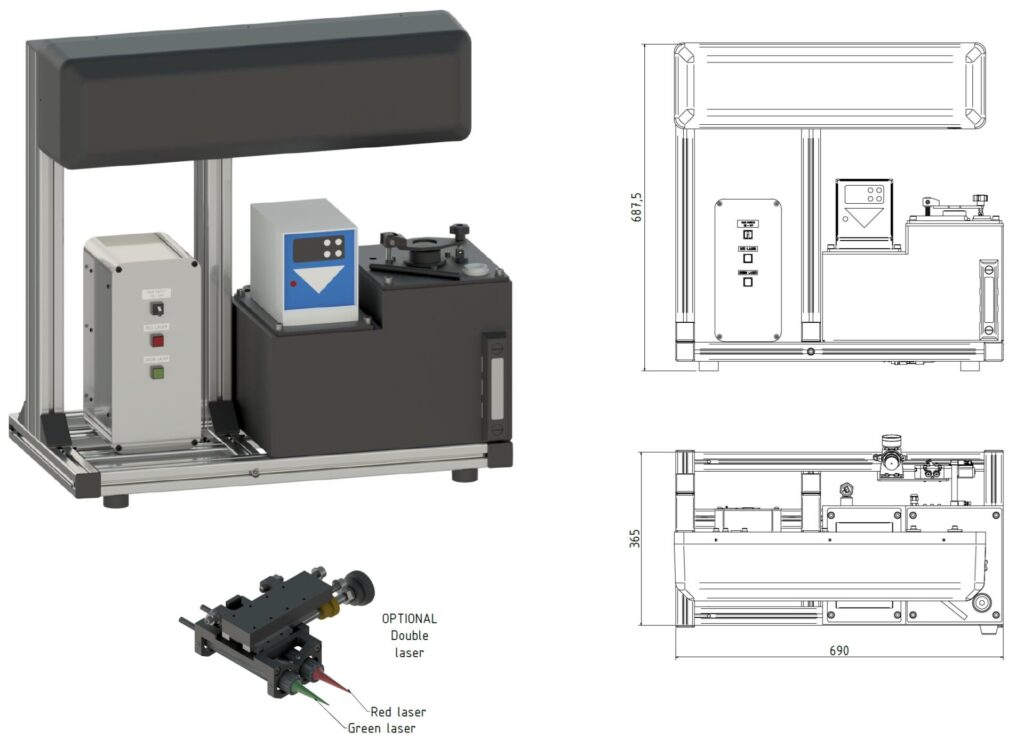
Technical features
Frame constructed from 40×40 mm and 40×80 mm ITEM aluminium profiles.
Stainless steel water container equipped with a drain plug.
Two black anodized aluminium lids enclosing the sample area and the heating system zone.
Internal ventilation system featuring a compact electric fan.
Heating system with integrated pump, 2 kW installed power, and temperature accuracy of ±0.1 °C.
Adjustable and easily interchangeable sample holder (one holder supplied for flat and spherical samples; custom shapes available upon request).
Mirror holder made of black anodized aluminium alloy, complete with sealing O-ring and clamping ring; mirror heating system powered by a 25 W low-voltage electrical resistance to prevent condensation. Power supply cables are fully protected and insulated.
Adjustable mirror holder with three stainless steel spring-loaded screws to ensure precise vertical return of the laser beam.
Motorized automatic shutter with a nylon slide to open/close the optical path to the mirror.
OPTIONAL: Adjustable guided dual-laser system (supporting red, green, or blue lasers)
Optical components
5 mW solid-state red laser (635 nm) with pinhole and 10× parallel beam expander (10 mm diameter).
35×35 mm square laser mirror.
50/50 beam splitter.
Biconvex lens with 200 mm Effective Focal Length (EFL), manufactured by ES USA.
Silicon detector with integrated electronic driving circuit, 50 mm² active area, 10 mm diameter diaphragm, and beam diffuser.
All components listed above are supplied with dedicated mounting holders.
Electronic devices
The following components are housed inside a robust steel and aluminium enclosure:
- Photoreceptor drive circuit with integrated power supply and amplifier.
- Power supply for the heating elements/resistances.
- Laser power supply module.
- Optical QUASM 7 Microprocessor connected to the PC via USB/Ethernet port for automatic operations control.
- Personal computer.
- 15.5” HP laptop PC pre-installed with dedicated proprietary software.
Software
- Original proprietary software developed by AD/GTM/QI.
- Compatible with Windows 11. (Nota: Rimosso “Full-scale setting” da qui poiché fa parte dei punti successivi).
- Full-scale setting capabilities:
- Maximum value calibration under full light.
- Minimum value calibration without light.
- Continuous real-time display of detected light intensity with a 0.05-second refresh rate.
- Automatic test start and shutter opening upon pressing the “Start” button, with a programmable delay (typically 0.5 seconds).
- Automatic duration measurement: the software calculates in real time the time required for light intensity to decrease to 80% of its initial value (accuracy: ±0.01 seconds).
- Automatic data logging to the hard disk after each test cycle.
- Data export in Excel format.
- Multi-language interface selection: English, French, and Italian are standard (German available upon customer-provided translation).
- Additional languages can be easily integrated (requires a standard Windows OS version).
- Report printing module with comprehensive sample identification data.
Software features
- High-speed processing across all operations.
- Highly flexible and easily customizable architecture. Compatible with all Windows-supported printers. (Nota: Ho sostituito Windows XP con un più generico ed attuale “Windows” dato che sopra si cita già Windows 11).
- Additional features available to meet specific requirements of the EN 168 standard.
General features
- Power supply requirements: Single-phase 220–240 V, 50/60 Hz.
- Overall dimensions (L × W × H): 900 × 400 × 700 mm.
- Required installation footprint: workbench/desk with minimum dimensions of 150 × 70 cm.
- Weight: 35 kg (excluding PC and the required 13 litres of demineralized water).
Scope of the device
Equipment designed for testing the resistance to fogging of oculars in compliance with EN 168, ECE 22/06, ISO 12311/12, and similar international standards.